Lighthouse vs Superdeal: a marketplace with escrow, or an assistant for every deal you already have
Superdeal wants the deal to run through Superdeal. Lighthouse works wherever the deal already is, which for most creators is their inbox.
By Ryan Figueroa, Co-founder of Lighthouse, full-time creator. .
Full disclosure: my brother Kevin and I build Lighthouse, so I'm biased.
Superdeal comes from a serious background. It's made by Mighty Joy, and its founder, Eric Dahan, co-founded Open Influence. The difference between Superdeal and Lighthouse isn't quality. It's where the deal lives: inside Superdeal's marketplace, or in the inbox where brands already email you.
Lighthouse vs Superdeal at a glance
| Lighthouse | Superdeal | |
|---|---|---|
| What it is | An assistant for your brand deals | A creator marketplace with an AI manager |
| Price for creators | $99/month or $940/year | Free creator profile |
| Commission | 0% | No creator fee. Brands pay a fee when a deal signs, and you keep the deal minus payment processing. |
| Works with | Any brand that emails you | Deals that run through Superdeal |
| Inboxes | Gmail and Outlook | Reads your inbox. Supported providers aren't listed. |
| How it prices a reply | From your past deals and the brand asking | From your saved rate card and deal terms |
| Contracts | Reviews the brand's contract against your email thread | Generates its own contract for each deal |
| Getting paid | Invoices any brand, follows up on late payments | Brand-funded escrow, released when content is approved |
| Deal tracking | A project page for every deal | A pipeline with next steps and due dates |
| Sends without your approval | Never | "AI drafts. You send." |
Superdeal details come from superdeal.io, its creator page and its about page. Its brand fee amount isn't published.
What does Superdeal do?
Superdeal describes itself as an agent-native creator marketplace. Brands, and the AI agents brands use, find creators there. On the creator side, its AI manager reads your inbox, flags the genuine offers, and lets you turn an email into a Superdeal deal in one click. It drafts replies from your saved rate card and deal terms, and you send them.
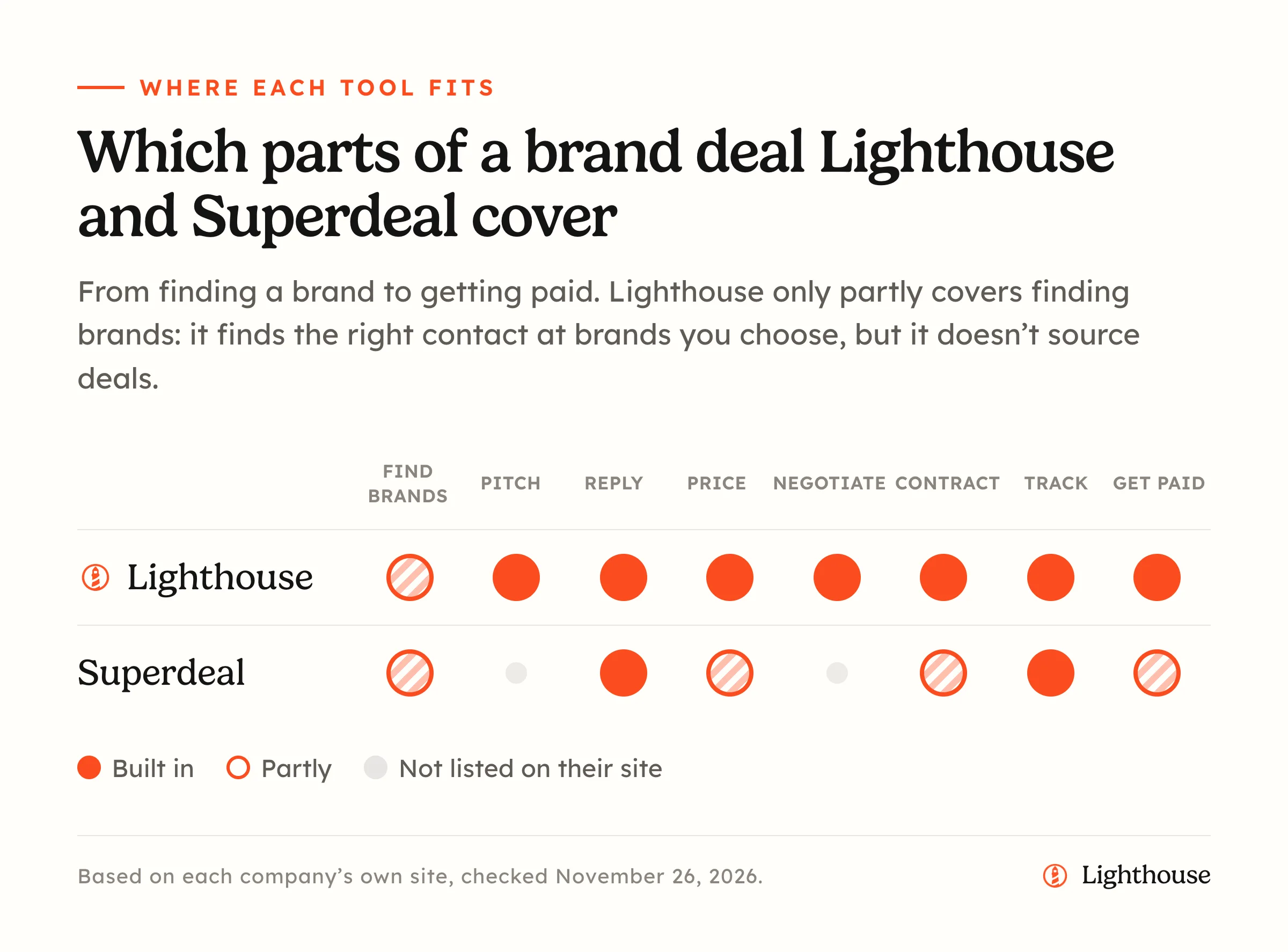
Once a deal is on Superdeal, it moves through a pipeline (new, in conversation, to review, to do, paid). Superdeal generates the contract, and the brand funds the deal into escrow, which is released when your content is approved. Superdeal says that means no invoicing and no chasing.
Does the deal have to run through the platform?
This is the core question.
Escrow is genuinely good for creators. Money sitting in escrow before you shoot is about as safe as brand deal payments get, and I'd never knock that. The catch is that escrow only covers deals that run through Superdeal. The brand has to agree to fund the deal there, sign Superdeal's contract and pay Superdeal's fee.
Plenty of brands won't. Bigger brands and agencies usually send their own contract and pay on their own terms, like net 30 or net 60. When one of them emails you, the deal happens on their paperwork, not a marketplace's.
Lighthouse doesn't ask the brand to change anything. It works on the deal wherever it already is. The brand emails you, Lighthouse drafts the reply, prices it, checks their contract, tracks the work and invoices them the normal way. That covers the deals a marketplace never sees.
What about the deals that don't go through escrow?
That's where getting paid gets hard, and it's most of a full-time creator's deals.
When a brand sends its own contract, Lighthouse reviews it against what you agreed over email and flags anything that changed, like 90 days of usage turning into 120. When the work is done, it creates the invoice and follows up when the brand is late. If you've ever waited on a brand that went quiet after you posted, you know that's where the real time goes. I wrote up what to do in a brand didn't pay you.
How does each one decide what to quote?
Superdeal's AI drafts replies from your saved rate card. That's consistent, and consistency is better than guessing.
Lighthouse goes a step further. It learns from your past brand deals and prices each offer for the brand asking. A Fortune 500 company that wants 90 days of paid usage gets a much higher number than a small brand asking for one organic post, because the deal is worth more to them. A rate card quotes both the same. More on that in how much to charge for a brand deal.
Where does Superdeal win?
- Escrow. On deals that run through it, the money is funded before you deliver. That's a real advantage.
- Free for creators. No monthly bill, and the fee falls on the brand.
- Brands looking for you. It's a marketplace, so brands and their agents can find you there. Lighthouse doesn't find deals for you.
- Simpler paperwork. Superdeal generates the contract, so there's no back and forth over terms on those deals.
Which should you choose?
- Choose Superdeal if you want to be found by brands in a marketplace and you like the safety of escrow on the deals that run there.
- Choose Lighthouse if most of your deals come straight to your inbox from brands with their own contracts and payment terms, and you want each one priced, checked, tracked and invoiced in one place for a flat $99 with 0% commission.
- Use both if you like. Deals that come in through Superdeal can run there, and everything that comes to your inbox runs through Lighthouse.
For the rest of the field, see the best AI tools for managing brand deals.
Frequently asked questions
Is Superdeal free for creators?
Creator profiles are free, and Superdeal says creators keep the agreed deal value minus payment processing. Brands pay a flat fee when a deal signs. Lighthouse is $99 a month with 0% commission.
Who is behind Superdeal?
Superdeal is made by Mighty Joy, based in Beverly Hills. Its founder and CEO, Eric Dahan, co-founded Open Influence.
What is escrow in a brand deal?
Escrow means the brand pays the money upfront to a third party, which holds it until the work is approved and then releases it to you. It protects you from a brand that doesn't pay. On Superdeal, it covers deals that run through Superdeal.
Does Lighthouse hold payments in escrow?
No. Lighthouse works with each brand's own contract and payment terms. It creates the invoice, tracks when payment is due and follows up when a brand pays late. For terms worth pushing for, see net 30 vs net 60 for creators.
About the author: Ryan is a full-time creator and filmmaker with 95K followers on Instagram (@ryansfigueroa) and brand deals with Adobe, ASUS, Perplexity and more. He has never signed with a manager or agency. He builds Lighthouse with his older brother Kevin, and has talked with over a hundred full-time creators about how they price, sign and get paid for their deals.
Try Lighthouse free for 30 days. $99/mo, 0% commission.