Lighthouse vs Emma (Retrograde): an AI manager you text, or a deal HQ you can see
Both promise to handle the business side of brand deals. The difference is how much you see, what you pay, and who presses send.
By Ryan Figueroa, Co-founder of Lighthouse, full-time creator. .
Full disclosure: my brother Kevin and I build Lighthouse, so read this knowing I'm biased.
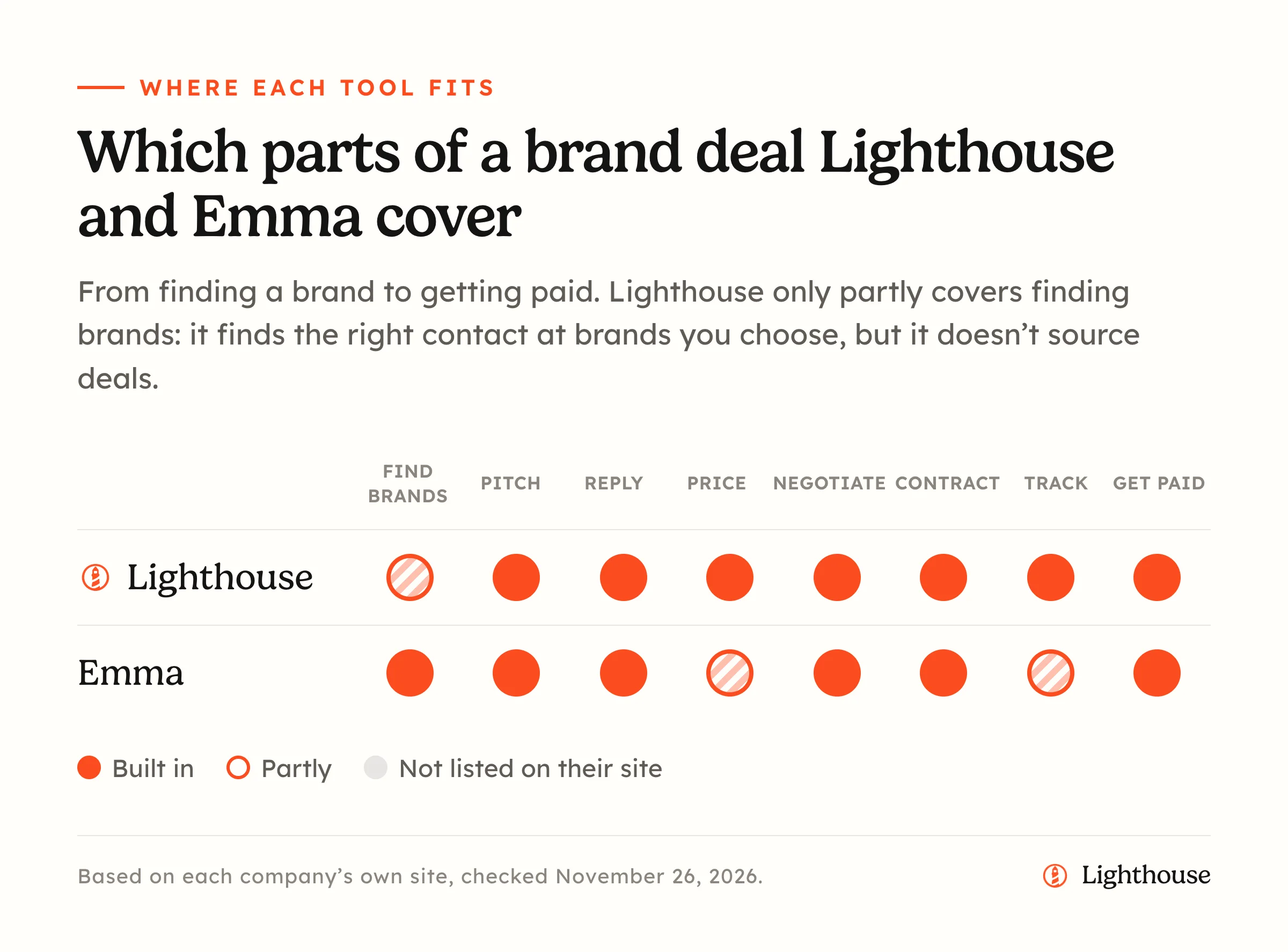
Emma is the closest thing to Lighthouse I've seen. Both handle replies, negotiation, contracts and invoices, and both connect to Gmail or Outlook. So this one isn't about missing features. It's about three choices: whether you text a manager or work from a workspace, whether your deals get pitched for you or priced for you, and whether you pay a flat fee or a cut.
Lighthouse vs Emma at a glance
| Lighthouse | Emma | |
|---|---|---|
| How you use it | A web workspace plus a mobile app | You text Emma |
| Price | $99/month or $940/year | Not listed on its site |
| Commission | 0% | 10% in 2025 coverage, current terms not listed |
| Inboxes | Gmail and Outlook | Gmail and Outlook |
| Sends without your approval | Never | Only if you turn on auto approval |
| Focus | The deals in your inbox, from first reply to paid invoice | Outbound outreach plus inbound offers |
| Pricing each offer | From your past deals and the brand asking | "Suggests pricing" |
| Contract review | Flags red flags and terms that changed from the email thread | Reviews contracts |
| Deal tracking | A project page for every deal, built automatically | Follow-up and deal memory |
| Invoicing and late payments | Built in, with follow-ups on late payments | Invoices and chasing payments |
Emma details come from itsemma.ai, its FAQ and its rebrand page. The 10% figure comes from 2025 launch coverage, not Emma's own site, so check current terms with them.
What does Emma do?
Emma is an AI manager from Creator Compute Company, the Dublin company that used to be called Retrograde. Grace Beverley is one of its co-founders. You text Emma, and according to its site it researches brands, finds the right contacts, drafts outreach, triages the offers that come in, reviews contracts, suggests pricing, and handles invoices and payment chasing. Its FAQ says emails go out from your own Gmail or Outlook.
By default you approve what Emma sends, with daily or weekly approval options. If you turn on auto approval, Emma sends emails without asking you first.
That's a serious product. If what you want is a manager-shaped thing you can message from your phone, Emma is built exactly for that.
Do you want to text a manager or see your deals?
This is the biggest difference, and it's a matter of taste as much as features.
With Emma, the interface is a conversation. You ask what's happening and it tells you. With Lighthouse, the interface is your deals. Every one of them has a project page with deliverables, deadlines, documents, the contract and the invoice, and every brand email already has a reply drafted in your voice. You open it and see the whole business at once, instead of asking about it one text at a time.
I like texting for quick questions. I don't like finding out what's due this week by scrolling up through a chat. When I'm running eight deals at once, I want to look at them, not ask about them.
The other half of this is control. Lighthouse never sends anything until you click send. That isn't a setting you can forget you turned on. Emma lets you switch on auto approval, which some creators will love. If you'd rather see every number before a brand does, that's the setting to leave off.
What do you actually pay?
Emma doesn't list a price on its site. Launch coverage in 2025 reported it at 10% commission on brand deals, half what a typical manager takes.
If that 10% is still current, here's the math on a single $5,000 deal: $500 to Emma. Do four of those in a year and that's $2,000, which is more than a full year of Lighthouse at $940. Lighthouse is $99 a month or $940 a year and takes 0% of anything, however big your deals get.
A cut makes sense when someone is out there landing deals you'd never have gotten. It makes a lot less sense on the deals that were already coming to your inbox. One UK creator I talked to said agencies "don't do anything apart from just replying to things that come into your email." She also said brands sometimes "turn down creators if they've got an agent." That's the problem with a percentage on inbound deals: you pay the most on the deals you needed the least help with. I did the full math on this in how much influencer managers take.
Where does Lighthouse go further?
Both tools claim pricing, contracts and invoices. Here's where I think Lighthouse is sharper.
- Pricing for the brand in front of you. Lighthouse learns from your past brand deals and prices each offer for the brand asking. A Fortune 500 company running paid ads gets a different number than a two-person startup, and usage rights, whitelisting and exclusivity all get priced in. Emma says it suggests pricing. Its site doesn't say what that's based on.
- Contract review against the thread. Lighthouse checks the contract against what you actually agreed over email. You said 90 days of usage, the contract says 120, and it flags it. More on why that matters in influencer contract red flags.
- Built for inbound first. Most of a full-time creator's deals arrive in their inbox. Lighthouse builds your workspace from those emails on day one, so the deals you already have get handled before anyone starts pitching new brands. It can also find the right contact at brands you want to pitch and draft the pitch when you're ready.
Where does Emma win?
- Outbound. If your priority is getting pitched to brands you've never heard from, Emma is built around outreach.
- Texting. If you'd rather run everything from your messages app, Emma's whole design is that.
- Hands-off sending. If you trust it and want emails going out without you, auto approval gives you that. Lighthouse won't.
- No monthly bill. If it's commission-only, you pay nothing until a deal closes. That matters when your income is lumpy.
Which should you choose?
- Choose Emma if you want a manager you text, you care most about outbound pitching, and a percentage of each deal feels fair to you.
- Choose Lighthouse if most of your deals already come to your inbox and you want every one of them priced for the brand asking, checked against the contract, tracked on its own page and invoiced, for a flat $99 and 0% commission.
For the rest of the field, see the best AI tools for managing brand deals, or how Lighthouse compares to a free reply drafter in Lighthouse vs Beacons Beam.
Frequently asked questions
Is Emma the same as Retrograde?
Yes. Retrograde rebranded as Creator Compute Company, and Emma is the name of its AI manager. The rebrand is announced on Emma's own site.
How much does Emma cost?
Emma's site doesn't list a price. Coverage of its 2025 launch reported a 10% commission on brand deals. Ask Emma directly for current terms before you sign up. Lighthouse is $99 a month or $940 a year with 0% commission.
Does Emma send emails without my approval?
Only if you turn that on. Emma's FAQ says it sends without asking only when auto approval is switched on, and otherwise you approve first. Lighthouse has no auto-send setting at all. Every email waits for you to click send.
Is Emma a talent agency?
Emma calls itself an AI manager. A lawyer who reviewed it in 2025 argued that a service like this can function like a talent agency because it goes out and procures work. If you're comparing it to a human manager, read its terms the way you'd read a management contract.
About the author: Ryan is a full-time creator and filmmaker with 95K followers on Instagram (@ryansfigueroa) and brand deals with Adobe, ASUS, Perplexity and more. He has never signed with a manager or agency. He builds Lighthouse with his older brother Kevin, and has talked with over a hundred full-time creators about how they price, sign and get paid for their deals.
Try Lighthouse free for 30 days. $99/mo, 0% commission.