Lighthouse vs Snippet: autopilot pitching or a deal you actually control
Snippet fills your outbox. Lighthouse handles what comes back, and it never sends anything you didn't read.
By Ryan Figueroa, Co-founder of Lighthouse, full-time creator. .
Full disclosure: my brother Kevin and I build Lighthouse, so I'm biased.
Snippet and Lighthouse both touch your Gmail and both draft emails in your voice, so they get lumped together. They're built for opposite ends of a brand deal. Snippet goes out and knocks on doors. Lighthouse is for when a brand knocks back, and for every step after that until the money lands. The biggest difference between them is how much gets sent before you've read it.
Lighthouse vs Snippet at a glance
| Lighthouse | Snippet | |
|---|---|---|
| Built for | Deals that land in your inbox, from first reply to paid invoice | Outbound pitching to brands that fit your content |
| Price | $99/month or $940/year | $9, $19 or $50/month, $500/year for Pro (listed on Product Hunt) |
| Commission | 0% | None ("Snippet takes no cut of your deals") |
| Inboxes | Gmail and Outlook | Gmail only |
| Sends without you | Never | Pitches you don't stop in the 24-hour review window go out (new accounts) |
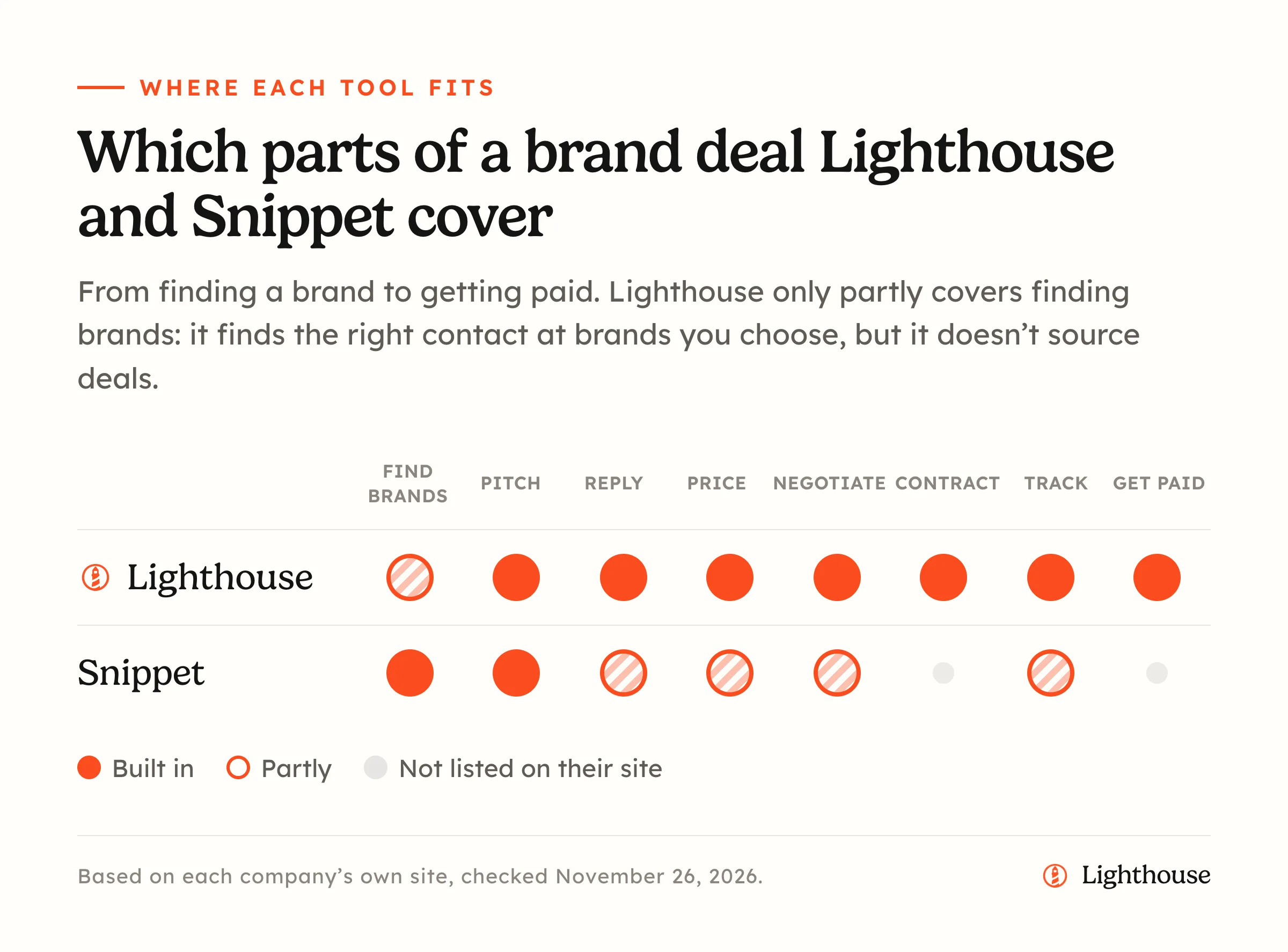
| Finds brands to pitch | Finds the right contact at brands you choose, drafts the pitch | Finds brands that fit your content and pitches them |
| How it prices a deal | From your past deals and the brand asking | Drafts counters at your rate |
| Contract review | Flags red flags and terms that changed from the email thread | Couldn't find it on their site |
| Invoicing and late payments | Built in, with follow-ups on late payments | Couldn't find it on their site |
| Deal tracking | A project page per deal with deliverables and deadlines | Shows your brand conversations from Gmail |
Snippet details come from its site and its Product Hunt listing, checked November 2026. Snippet's own pages didn't show plan prices when I checked, so confirm on their site before you sign up.
What does Snippet do?
Snippet calls itself an AI talent manager. It finds brands that fit your content, drafts pitches in your voice and at your rate, and sends the pitches and follow-ups from your own Gmail. When a brand replies, it can draft a counteroffer, or a reply to a free-product or lowball offer. You can connect Instagram, read-only, so it can learn your content. There's no minimum audience size, and it takes no cut of your deals.
If your problem is that no brands email you, that's a real problem, and Snippet is aimed straight at it.
How much does Snippet send without you?
This is the part I'd read carefully before connecting anything.
Snippet's site says new accounts get a 24-hour review window. Pitches you don't stop within that window go out. You can switch to approve-only, and the site also says you approve every deal. A Product Hunt listing also mentions a full autopilot option. That's second-hand, so check Snippet's current settings yourself.
So by default, a new account can send pitches from your Gmail, under your name, that you never opened. Why that matters:
- Your name is on every email. A pitch to the wrong brand, at the wrong rate, or with a weird line in it is a first impression you can't take back.
- Brand fit is a judgment call. A tool can match keywords. It doesn't know which brand you'd never work with, or the one you already turned down.
- Your inbox reputation is shared. Lots of cold email from your main Gmail can hurt how your real brand replies get delivered. Brands already deal with a flood of junk and scam pitches, so volume alone doesn't help you stand out.
Lighthouse never sends anything you haven't approved, and there's no setting that changes that. Pitches, replies, counters and invoices all wait for your click.
What happens once a brand replies?
Snippet drafts a counteroffer at your rate. That's a good start, but a rate is one number, and brand deals aren't one number.
Lighthouse learns from your past brand deals and prices each offer for the brand asking. A Fortune 500 brand that wants 90 days of paid usage gets a different quote than a small brand asking for one organic post. Usage, whitelisting and exclusivity get priced in as their own lines. More on that in how much to charge for a brand deal.
Then the parts most of the money depends on:
- The contract. Lighthouse checks the brand's contract against what you agreed over email and flags anything that changed, like 90 days of usage turning into 120. I couldn't find contract review on Snippet's site.
- The work. Every deal gets a project page with deliverables, deadlines and documents, synced to your calendar.
- Getting paid. Lighthouse creates the invoice and follows up when a brand pays late. I couldn't find invoicing on Snippet's site.
Lighthouse pitches too. It finds the right contact at a brand you want to work with and drafts a pitch in your voice, and you send it. One creator watched it pull the right contact and draft the pitch on a call and said, "you've created something that was in my head... I'm a little bit blown away."
Where does Snippet win?
- Volume. If you want to reach a lot of brands fast and you're fine with a review window, Snippet is built for that.
- Price. The listed plans start at $9 a month, which is hard to argue with if you're just getting started.
- Brand discovery. It finds brands that fit your content for you. Lighthouse drafts pitches to brands you pick.
- You're early. If you get almost no inbound, outbound is the job that matters right now.
Which should you choose?
- Choose Snippet if your inbox is quiet, you want outreach at volume, and you're comfortable either reviewing inside the window or switching to approve-only.
- Choose Lighthouse if brands already email you and you want every reply, price, contract and invoice handled in one place, with nothing sent that you didn't read.
- Use both if you want Snippet to start conversations and Lighthouse to work the deals that come back. Just make sure only one tool is replying to a given brand.
For the rest of the field, see Lighthouse vs Beacons Beam and the best AI tools for managing brand deals.
Frequently asked questions
Does Snippet send pitches automatically?
For new accounts, effectively yes. Snippet says new accounts get a 24-hour review window, and pitches you don't stop go out. You can switch to approve-only. Lighthouse never sends anything without your approval.
How much does Snippet cost?
Its Product Hunt listing shows Starter at $9 a month, Plus at $19 and Pro at $50 a month or $500 a year, with a 7-day Pro trial. Snippet's own pages didn't show prices when I checked, so confirm there. Lighthouse is $99 a month or $940 a year with 0% commission.
Does Snippet work with Outlook?
Snippet says it only sends email from your own Gmail. Lighthouse works with Gmail and Outlook, including Google Workspace and Microsoft 365 custom domains.
Is it risky to let an AI send cold pitches from my Gmail?
It can be. Every pitch goes out under your name, a poor brand match is a first impression you can't undo, and high cold-email volume from your main inbox can affect how your other email gets delivered. Read pitches before they send, or use a tool that waits for your approval.
About the author: Ryan is a full-time creator and filmmaker with 95K followers on Instagram (@ryansfigueroa) and brand deals with Adobe, ASUS, Perplexity and more. He has never signed with a manager or agency. He builds Lighthouse with his older brother Kevin, and has talked with over a hundred full-time creators about how they price, sign and get paid for their deals.
Try Lighthouse free for 30 days. $99/mo, 0% commission.